

Attention Is All You Need — The Architecture That Redefined Modern AI
EN
English Prompt
A high-end sci-tech visual poster summarizing the classic paper "Attention Is All You Need," in 16:9 horizontal format, suitable for social media video covers, PPT title slides, and key visuals for technology content. The overall style is not a traditional academic poster, not like a textbook illustration, and not like an ordinary paper summary graphic. Instead, it should resemble a "viral paper visualization cover" produced by a top-tier tech media outlet: premium, clean, striking, highly futuristic, with clear information but without being overly academic.
Overall artistic direction:
Reference the visual styles of Apple keynotes, top-tier AI launch events, and tech cover designs from WIRED, Bloomberg, or NVIDIA. The image should have infographic qualities while delivering a powerful key visual impact. Avoid pure white academic backgrounds; instead, use a premium dark background with black-gray-blue gradients, featuring subtle spatial depth, volumetric light, glass textures, metallic textures, and flowing digital network effects. The image should be refined and polished, like something that can genuinely serve as a video cover or presentation title slide.
Layout requirements:
Adopt a more design-driven, non-rigid layout rather than stiff three-column blocks. Avoid neat, rigid rectangular cards. Center the composition around "one super-strong hero visual + several concise information modules."
Place an oversized English title at the top left, serving as the primary visual anchor point.
Position a massive, refined, semi-transparent, luminous Transformer core structure as the central visual slightly toward the middle-right. It should look like a futuristic computing engine or neural network core device, not a mundane 2D block diagram.
On the left side, keep only a minimal set of "pain points of old models" information, presented as three small modules or icons.
On the right side, keep only two concise information groups: "Key Innovations" and "Historical Impact," with very little text.
At the bottom, retain an elegant, streamlined process flow line as auxiliary explanation, not too eye-catching.
Title text requirements:
The main title must be in English, extremely prominent, clean, and powerful:
Attention Is All You Need
The subtitle, one size smaller, placed below the main title:
Introducing the Transformer Architecture, Redefining the Direction of Modern Artificial Intelligence
All other explanatory text must be in clear and readable English, with no garbled characters, no typos, and no deformation.
The font style should be modern, restrained, and highly technological, resembling the clean sans-serif fonts used in premium brand launch events.
The English title should have heavy font weight with clear hierarchy; all descriptions should be sharp and concise, avoiding large blocks of academic paper-style text.
Left information zone:
Title:
Why Old Models Fell Short
Only three brief statements:
RNN: Sequential computation, difficult to parallelize
LSTM: Long-range dependencies remain challenging
CNN: Limited receptive field pathways
Minimalist icons or small schematic diagrams may accompany the left side, but must remain premium, restrained, and clean.
Central hero visual:
Render the Transformer structure as an ultra-refined, futuristic, semi-transparent, layered floating structural device.
Clearly present these labels:
Encoder
Decoder
Multi-Head Attention
Masked Multi-Head Attention
Feed-Forward Network
Positional Encoding
Input Embedding
Output Embedding
Linear Layer
Softmax
But do not make it a textbook-style rigid block diagram.
Make these modules appear as floating glass information layers, luminous modules, futuristic interface components, with clear hierarchy and orderly structure, like the "core engine of the AI era."
Add a small amount of elegant glowing connection lines, particle streams, and data pathways to enhance visual impact.
Right information zone:
Title one:
Key Innovations
Content limited to four short phrases:
Self-attention replaces recurrence
Multi-head attention captures diverse relationships
Positional encoding injects sequence order
Training is highly parallelizable
Title two:
Historical Impact
Content limited to three short phrases:
Laid the foundation for large language models
Drove the rise of BERT, GPT, ViT, and multimodal AI
Became the core architecture of modern generative AI
Bottom process flow line:
Use an extremely minimalist, fluid, glowing-arrow visual process flow showing:
Input Tokens → Embedding + Positional Encoding → Encoder Stack → Decoder Stack → Next Token Prediction
Attention visualization:
A small but refined token connection schematic may be included in a localized area of the image, using tokens:
I / Love / Artificial / Intelligence
Tokens connected by fine, glowing connection lines, illustrating the self-attention mechanism.
This part must be delicate, compact, and resemble a premium UI component, not a teaching illustration.
Visual quality requirements:
The overall look must be more of a "tech cover" than an "academic infographic."
There must be clear primary-secondary hierarchy and visual rhythm, with a strong hero visual, refined information zones, and ample negative space.
Avoid an overcrowded composition, densely packed explanatory text, excessive bordered cards, and the blue-and-white office template feel.
Make people feel at first glance: this is not an ordinary paper summary, but an exceptionally premium, highly impactful AI paper cover image.
Color requirements:
Deep black, graphite gray, silver gray, and cool white as the main palette, accented with small amounts of electric blue or icy cyan highlights.
Incorporate glassmorphism, glowing edges, subtle reflections, and spatial mist in localized areas.
Overall premium, cool, and futuristic, without being flashy or cheap.
Image quality requirements:
4K, UHD, ultra detailed, super sharp, cinematic lighting, editorial cover design, premium tech infographic, glassmorphism, futuristic interface, high-end presentation cover, crisp text edges, precise layout, publication-quality, studio quality.
CN
Chinese Prompt
论文博客总结
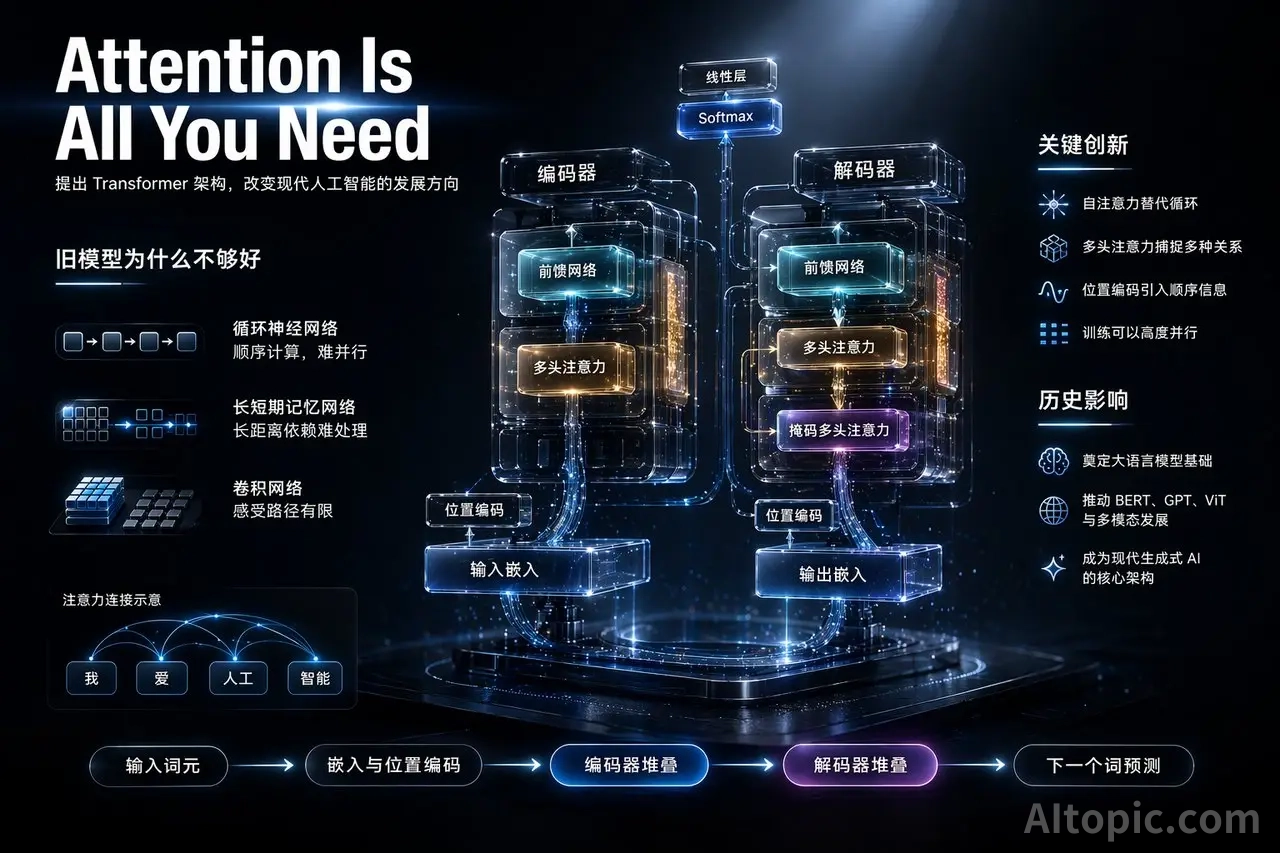
一张用于总结经典论文《Attention Is All You Need》的高端科技视觉海报,16:9 横版,适合自媒体视频封面、PPT 首页、科技内容主视觉。整体风格不是传统学术海报,不要像教材插图,不要像普通论文总结图,而要像顶级科技媒体制作的“爆款论文可视化封面”:高级、简洁、震撼、未来感强、信息清晰但不过度学术化。
整体艺术方向:
参考 Apple keynote、顶级 AI 发布会视觉、WIRED / Bloomberg / NVIDIA 风格的科技封面设计。画面既有信息图属性,又有强烈主视觉冲击。不要纯白学术背景,改为深色高级背景,黑灰蓝渐变,带轻微空间感、体积光、玻璃质感、金属质感、数字网络流动感。画面精致,像真正可以拿来做视频封面和演讲首页。
版式要求:
采用更有设计感的非死板三栏布局,不要整齐僵硬的大量矩形卡片。整体以“一个超强主视觉 + 几组精炼信息模块”为核心。
顶部左侧放超大英文标题,形成第一视觉锤点。
中间偏右放一个巨大、精致、半透明、发光的 Transformer 核心结构主视觉,像未来计算引擎、神经网络核心装置,而不是普通二维框图。
左侧只保留少量“旧模型痛点”信息,用 3 个小型模块或图标呈现。
右侧只保留“关键创新”和“历史影响”两组简洁信息,不要太多字。
底部保留一条很优雅的流程线,作为辅助说明,不要太抢眼。
标题文字要求:
大标题必须使用英文,并且非常醒目、干净、有力量:
Attention Is All You Need
副标题使用中文,小一号,放在标题下方:
提出 Transformer 架构,改变现代人工智能的发展方向
其余说明文字全部使用中文,要求清晰可读、无乱码、无错别字、无变形。
字体风格现代、克制、科技感强,类似高端品牌发布会常用无衬线字体。
英文标题字重大、拉开层级;中文说明简洁锐利,避免学术论文式大段文字。
左侧信息区:
标题:
旧模型为什么不够好
仅保留三条简洁信息:
循环神经网络:顺序计算,难并行
长短期记忆网络:长距离依赖难处理
卷积网络:感受路径有限
可在左侧配极简图标或小型示意图,但一定要高级、克制、简洁。
中央主视觉:
将 Transformer 结构做成超精致、未来感、半透明、分层悬浮的结构装置。
清晰呈现这些中文标签:
编码器
解码器
多头注意力
掩码多头注意力
前馈网络
位置编码
输入嵌入
输出嵌入
线性层
Softmax
但不要做成课本式死板框图。
要让这些模块像漂浮的玻璃信息层、光效模块、未来界面组件,层级清晰,结构秩序明确,像“AI 时代的核心引擎”。
可以加入少量优雅的发光连接线、粒子流、数据路径,增强视觉冲击。
右侧信息区:
标题一:
关键创新
内容只保留 4 条短句:
自注意力替代循环
多头注意力捕捉多种关系
位置编码引入顺序信息
训练可以高度并行
标题二:
历史影响
内容只保留 3 条短句:
奠定大语言模型基础
推动 BERT、GPT、ViT 与多模态发展
成为现代生成式 AI 的核心架构
底部流程线:
用一条极简、流畅、带发光箭头的视觉流程展示:
输入词元 → 嵌入与位置编码 → 编码器堆叠 → 解码器堆叠 → 下一个词预测
注意力示意:
可在画面局部加入一个很小但精致的词元连接示意,使用中文词元:
我 / 爱 / 人工 / 智能
词元之间以细致发光连线相连,体现自注意力机制。
这个部分要精致、小巧、像高级 UI 组件,不要像教学插图。
视觉气质要求:
整体必须更像“科技封面”而不是“学术信息图”。
要有明显的主次关系和视觉节奏,主视觉强,信息区精炼,留白充足。
避免画面过满,避免密密麻麻的说明文字,避免太多边框卡片,避免蓝白办公模板感。
让人一眼感觉:这不是普通论文总结,而是一张非常高级、非常能打的 AI 论文封面图。
色彩要求:
深黑、石墨灰、银灰、冷白为主,搭配少量电蓝或冰青高光。
局部可加入玻璃拟态、发光边缘、细微反射、空间雾感。
整体高级、冷静、未来,不花哨,不廉价。
画质要求:
4K,UHD,ultra detailed,super sharp,cinematic lighting,editorial cover design,premium tech infographic,glassmorphism,futuristic interface,high-end presentation cover,crisp text edges,precise layout,publication-quality,studio quality
Comments & Questions (0)
No comments yet
Be the first to comment!